Tag Archives: personal finance

Empowering Financial Resolutions for 2024

Charting a Path to Prosperity

In 2024, as we embark on a new year, it presents the perfect opportunity to transform your financial resolutions from mere aspirations into empowering steps toward achieving your dreams. The journey to financial fitness is not solely about numbers; it is about crafting a life filled with accomplishment, peace of mind, and long-term security.

You can make this year your most prosperous by setting clear goals, creating a comprehensive budget, exploring investment opportunities, and continuously educating yourself about personal finance. So, let’s embrace this exciting journey together and make every decision count for a brighter financial future! 

Resolution 1: Forge Your Financial Blueprint

Imagine a future where your finances support your day-to-day needs and fuel your wildest dreams and aspirations. It all starts by meticulously constructing a well-thought-out budget that aligns perfectly with your unique life goals, ensuring that every dollar is allocated purposefully and strategically.

In this financial utopia, you embrace the powerful philosophy of “paying yourself first” – a mindset that compels you to prioritize saving and investing, allowing your wealth to grow steadily over time. By consistently setting aside a portion of your income, you are actively building a solid foundation for long-term financial success.

To gauge your progress and stay on track, it is essential to calculate your net worth annually. This comprehensive evaluation provides:

  • A holistic view of your financial health.
  • Giving you insights into your assets and liabilities.
  • Overall progress toward achieving your financial goals.

Strategic planning becomes your secret weapon when confronted with significant expenses or future financial milestones. You can confidently navigate these milestones without derailing your economic well-being by proactively saving and investing in ways that align with your specific time horizons.

Safeguarding your living-expense money becomes paramount for those approaching retirement or already in their golden years. By adopting a conservative investment approach, you can protect your hard-earned savings while still generating a steady income to support your desired lifestyle during retirement.

Life is unpredictable, and that’s where the importance of an emergency fund becomes evident. Creating a safety net for life’s unexpected twists and turns offers you peace of mind and financial security, allowing you to weather any storm that comes your way without compromising your long-term financial goals.

So, picture this future where your finances are not just a means to an end but a powerful tool that propels you toward the life you’ve always envisioned. Start today by constructing a budget, embracing the philosophy of “paying yourself first,” calculating your net worth, planning for future expenses, safeguarding your retirement, and creating an emergency fund. With these proactive steps, you can transform your financial journey and make your dreams a reality.

Resolution 2: Master Your Debt

Debt can be a powerful financial tool if used wisely and managed effectively. By carefully working your debt load, you can ensure that life’s pleasures and necessities remain within reach without overwhelming yourself. One effective strategy is eliminating high-cost, non-deductible consumer debt, allowing you to allocate your resources more efficiently. Another approach is to align your repayment terms with your life’s timeline, enabling you to balance your financial obligations with your long-term goals.

Additionally, it is worth considering the benefits of refinancing or consolidating debt, which can help optimize your repayment strategy and potentially reduce the overall cost of debt. By taking these proactive steps, you can leverage the potential of debt while maintaining a healthy financial outlook.

Resolution 3: Cultivate Your Investment Garden

Ensure the prosperity of your investments by prioritizing a well-rounded and diversified portfolio. By diversifying across various asset classes and within them, you can effectively minimize risk while maximizing your growth potential.

Additionally, it is essential to remember the impact of taxes when allocating your assets. To maintain alignment with your goals and adapt to life changes, make it a habit to monitor and rebalance your portfolio regularly. This diligent approach will help you navigate the ever-changing investment landscape with confidence.

Resolution 4: Safeguard Against the Unknown

Life is full of unexpected twists and turns, but being prepared can make all the difference. Take proactive steps to protect yourself and your loved ones by investing in comprehensive insurance plans covering various life aspects. Consider health insurance for medical expenses, life insurance for financial security, disability insurance for income protection, property insurance for safeguarding your assets, and liability insurance for unforeseen circumstances.

Additionally, don’t overlook the significance of long-term care insurance to ensure you have the necessary support in your golden years. Lastly, create a well-thought-out disaster plan to safeguard your assets and provide peace of mind. Taking these precautions allows you to navigate life’s uncertainties with confidence and security.

Resolution 5: Preserve Your Legacy

An estate plan is not just a legal document; it’s your heartfelt love letter to the future. It ensures that your hard-earned assets and beloved dependents are taken care of exactly as you desire. To maintain the effectiveness of your estate plan, it is crucial to review and update beneficiary designations and your will regularly.

Additionally, coordinating asset titling with your estate plan can help streamline the distribution process. In more complex situations, establishing trust may be warranted to provide added protection and flexibility. Lastly, it is crucial to ensure that your estate documents are easily accessible to trusted individuals who can carry out your wishes with confidence and care.

In 2024, seize the opportunity to build a brighter financial future. This year is not just a simple milestone; it’s a chance to embark on a transformative journey toward abundance and peace of mind. Embrace these resolutions as your stepping stones, each one paving the way to a life filled with financial prosperity and the realization of your dreams.

Remember, taking them one at a time will allow you to witness the remarkable transformation of your financial health, bringing you closer than ever to the life you’ve always envisioned.

Don’t Wait Until the Last Minute: 2024 Tax Filing Season is Coming

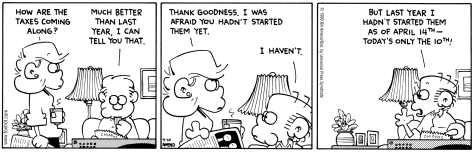
Was this you last year? Or the year before that? Regardless of when you actually file your return, we’ve long recommend preparing for tax season throughout the year to try and relieve some of the stress (see our post from 😮 almost 10 years ago below 🔽).

Here are 15 updated tips to get you prepped for tax season and to keep more money in your pocket. We’ve tried to arrange them in order for those Gen Zers who we still can’t believe are even old enough to be filing taxes. Guess that free trial ended – sorry y’all! And we know 15 is a long list but get used to it because you’re adulting now.

  1. Reduce taxable income by saving for retirement through an employer-sponsored plan.
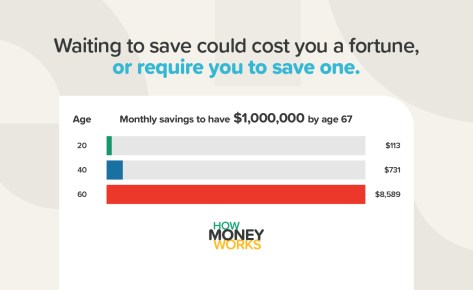
    As soon as you’re eligible (it varies from job to job), start making contributions to your retirement plan through your employer. YES, we mean you Gen Z kid that just started your first job out of high school or college. Even though retirement seems a lifetime away, it’s not only cheaper to start doing it now (you can get away with stashing $100/month and still potentially retire a millionaire) but you also end up having less federal income tax taken out of your check because you’re saving for retirement. Oh and there’s another benefit…
  1. Get paid to save for retirement with the Saver’s Credit based on contributions up to $2000.
    Yes, you read that right! The IRS will actually credit you up to $1000 ($2000 if married filing jointly) if you’re saving for retirement.
    Here’s how it works: be 18 or older, not a dependent and not a student. Save up to $2000 for retirement through your employer or your IRA (that’s an Individual Retirement Account) and based on your adjusted gross income (AGI) you could qualify for the max credit of $1000 or 50% of what you saved. You won’t see $1000 in the form of a refund but it will be subtracted from whatever your tax bill is. Don’t know what your AGI is or even where to find it? That’s something we need to talk about!
  2. Take advantage of education credits.
    Did you go back to school and eliminate yourself from being able to qualify for the Saver’s Credit we just mentioned? Don’t worry because there are education credits that you may be eligible for, namely, the American Opportunity Credit of up to $2,500 or the Lifetime Learning Credit that goes up to $2,000. The qualifications are different for each credit but regardless make sure to keep track of your expenses like tuition, enrollment fees, course-related books, supplies and equipment as both are based on how much you spent on these items.
  3. Claim tax benefits for qualifying relatives.
    Most people are aware that they can claim their children on their taxes. But did you know that if you are the primary provider for a parent or grandchild, you may qualify for additional tax benefits. It’s worth checking with your tax professional for the specifics on credits like the Child and Dependent Care Credit, so start adding up those expenses.
  1. Reduce out of pocket childcare costs if your employer offers dependent care benefits.
    If you have a tax deduction, oh um a child, and your employer offers you dependent care benefits, make sure you’re using them. This allows you to pay for daycare and extended day services at school with pre-tax dollars.
  2. Plan ahead for college expenses by saving with a 529 plan.
    Concerned about paying for those children to go to college? Start saving now. This isn’t a tax deduction for your current return but the earnings made in the plan are exempt from income tax as long as those little buggers go to college and the money is used for those expenses. In some cases you can even use up to $10,000 a year without being taxed to send them to a private K-12 school. The plans vary from state to state so it’s best to check and see what’s available where you live. Not 100% sure that child is going to go to college? Ask your financial pro about UTMA/UGMAs.
  3. Maximize HSA contribution to decrease taxable income.
    Similar to the dependent care FSA mentioned in Part 1, health savings account contributions decrease the amount of taxes you pay in the year you make contributions. The trick is that HSAs aren’t available to everyone as they are meant for people with high deductible health insurance plans. However if you do have access to one, not only can you stash money pre-tax to cover your medical expenses like eyeglasses, prescriptions and doctor visits, but the account can earn interest and rolls over from year to year and from employer to employer.
    If you don’t qualify for an HSA perhaps your employer provides access to a Medical FSA. You can elect how much to contribute from your pre-tax income and use the funds on medical expenses. Here’s where this account gets tricky. The funds are a use-it or lose-it deal so you need to be really good at estimating how much you’re going to spend in a calendar year or risk losing some cash.
  4. Put your tax refund to work by paying off high interest debt, creating an emergency fund, or saving for retirement.
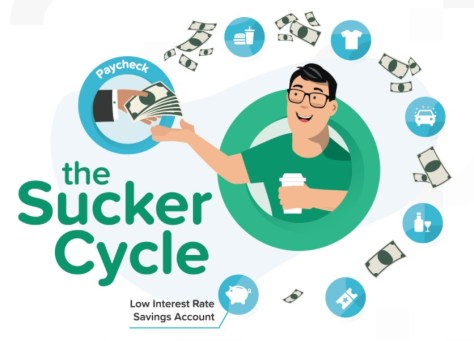
    We see it year after year, a surge in used car sales and electronics purchases. But thankfully in this recent survey, most U.S. adults were planning to save their tax refund. The trick is to not save it in a low interest rate savings account like Clark below is doing. Thankfully it’s easier to find a higher interest rate savings account due to the Fed’s rate hikes this past year. Just make sure you’re taking advantage of it.
  1. Start saving for a down payment on a house.
    Maybe you’ve already paid down your debt with past refunds, have an emergency fund and are a regular retirement saver. Is it your dream to own a home? Then apply your refund to that savings bucket. True the mortgage interest rates are starting to go down but that doesn’t mean you need to have less saved. Check out this post about the importance of the home price and the mortgage rate.
  2. Take advantage of catch up retirement contributions if you’re 50+.
    Didn’t start saving for retirement with that first job? While you might be behind in your savings you don’t have to stay that way. The limits on contributions range from $1000 to $3,500 higher if you’re 50 or older, depending on the account type. So find a way to minimize other expenses or stack up some cash gifts right now so you can max out your contributions. Remember that you have until the filing deadline to make contributions for 2023.
  3. Consider the tax consequences before taking money out of your retirement account.
    This one might not seem like something you need to be concerned about if you’ve already past retirement age. You might be thinking that since you’re past that 10% penalty age period it’s time to withdraw like crazy. Not so fast! If that money is coming out of a 401(k) or some other tax-deferred account the IRS wants their share now. And if you’re on Social Security pulling too much out in a year could also make your Social Security payments taxable. So make sure to have a chat with either your tax or financial professional before taking that money out.
  4. Know which tax bracket you’re in.
    As a follow up to the last step, keep track of which tax bracket you’re in. That can help you estimate how much tax will need to be withheld for any distributions from your retirement account regardless of if you’re past the point of the 10% penalty or not. Also it helps you more accurately estimate what tax may be due on additional funds you earn throughout the year from nontraditional employment or other sources.
  5. Make estimated payments to avoid underpayment penalties.
    Did you take our advice from our Divorce Your Job series or our posts on starting your own side hustle? Yes, we even mean you Uber drivers and Instacart shoppers. Well watch out for an increased tax liability since you’re now considered a business owner in the eyes of the IRS even though you may only think of it as a side gig. Make estimated tax payments throughout the year to avoid wasting money on penalties.
cartoon about taxes
  1. Document your business expenses to lower tax liability including up to 100% of health insurance costs.
    And we don’t mean document like in the comic above. Need tips on how to keep track of all of your business expenses? While Quicken is a software we’ve used in the past and Quickbooks is always a great go-to, maybe you’re not ready to learn a new program.
    Join us on February 1st at 8:00 PM ET for our FREE, live Entrepreneurship class and ask about other tracking options.
  2. Subcontract and deduct non-core administrative expenses.
    Getting bogged down with administrative tasks instead of focusing on the key activities of your business? Hire somebody else to do it for you and deduct the cost from your taxes. You don’t have to file any tax paperwork until you reach $600 paid for services. The form that you’d end up filing is the 1099-NEC. Looking for a virtual assistant to handle calendar management, social media and other admin tasks for you? We’ll share a tip for that during the live class in February so make sure to mark your calendar or you can talk to us via our social media if you need the deets sooner.

What we’ve been doing on our hiatus – pt 2

How the new office started Yes we've been on hiatus & you haven't been getting your 3 weekly posts in March, but here's why

The same images but with the word descriptions that were supposed to be displayed in part 1.

And now for part 2 photos…

How the new bedroom started... did you want the director of content sleeping on the floor?

Millennials, want to catch a 🆓 version of the personal finance class your Boomer parents should have made sure was available to you when you were a kid? Click here to register for the class happening Thursday, July 1sy at 8 PM EST.

Millennials only!!! (born between 1980 and 1995)

Opportunity Cost and Your Career

“Opportunity cost” refers to what you can potentially lose by choosing one option over another – even when you aren’t thinking about it.

Nearly every choice you make precludes something else that might have been.

Opportunity cost exists in everything from relationships to finances to career choices, but here we’ll focus on that last one. Over a lifetime, the cost of career decisions can be massive.

numbers money calculating calculation
Photo by Breakingpic on Pexels.com

The math
For opportunity costs that can be measured, usually in dollars, there’s even a math equation. (FYI, Ms. ME spent a few years as a Mathematics instructor.)

What I sacrifice / What I gain = Opportunity cost[i]

Let’s say you have two career choices. One is to work as a mechanic at $50 per hour and the other is to work as a karate instructor at $20 per hour.

Opportunity A / Opportunity B = Opportunity cost

Here it is with numbers: $50 / $20 = $2.50

To translate that, for every $1 you earn as a karate instructor, you could have earned $2.50 as a mechanic. The ratio remains the same whether it’s for one hour worked or 1,000 hours worked because it’s based on earnings per hour.

round silver colored wall clock
Photo by Oladimeji Ajegbile on Pexels.com

Adding a time element
We can only work a certain number of hours in a week and we can only work for a certain number of years in a lifetime. Adding time into the discussion doesn’t change the math relationship between the opportunities but it does recognize real-world constraints. Sometimes these limits are by choice. You could be both a full-time mechanic and a full-time karate instructor, but most people don’t want to work 80 hours per week. Something has to give, and that’s where considering opportunity cost comes in.

If you only want to work 40 hours in a week, you’ll have to choose one career over the other or split your time between the two. But even in splitting your time, there is an opportunity cost. Think about it like this: Every hour spent in a lower paying job costs money if you had an opportunity to earn more doing something else.

The bigger picture
In our example using the mechanic vs. the karate instructor, the difference in annual income is over $60,000 per year ($104,000 minus $41,600). Over a 40-year working career, the difference in earnings is nearly $2.5 million, and it all happened one hour at a time.

10703511_10153286388927564_8852039904301114878_n

Life balance
Your career choice shouldn’t just be about money – you should do something you enjoy and that gives you satisfaction. There may be several other considerations as well – like opportunity to travel, the kind of people you work with, and the greater contribution you can make to the world. However, if there are two choices that meet all your criteria but one pays a bit more, just do the math!

Strange as it may sound thanks to Covid-19 and everything else that happened in 2020 many people are doing the math and reevaluating what they want to do with their lives. For some, reconnecting with a long lost passion as a side gig or even a full leap into entrepreneurship is the direction that they are considering to achieve their desired level of wellness. If you’re in this category, tell us in the comments below. 🔻

[i] https://blog.udemy.com/opportunity-cost-formula/

Why Everyone Wants Your Money NOW

Instant Gratification Has Overtaken Your Financial Power.

“Waiting sucks!” How many times have you thought that? While it may not feel great at the moment, waiting when it comes to spending is key to reclaiming your financial power. Remembering that old adage that “patience is a virtue” can be extremely tough in this age of instant gratification.

In today’s world you can buy now, one click order, get no interest down, and enjoy same day shipping—but have you asked why? Why is it so ridiculously easy for you to spend your money? Is it…

  1. Because they’re committed to your convenience? (You can’t be that naive.)
  2. Because you’ll buy from their competitor if they don’t? (#Facts but..)
  3. Because they want your money, they want it all, and they want it now?
Seriously still find it hard to believe I didn’t realize Queen was behind most of my childhood favs until that movie – Ms. ME

DING, DING, DING!!! We’ve found our answer at #3. Understand that your need for instant gratification is a conditioned response. When you’re first born into the world, you want everything ASAP. And as a baby that’s mostly ok because what you want is essential, food, love, to not be lying in your own 💩. But as you get older, good parents teach their children to wait which is why we get the terrible twos. That’s the period where we fuss and complain and generally are a nightmare to be around until we learn that you can’t always get what you want.

Unfortunately retailers have spent decades undoing the hard work your parents put in to recondition you to expect instant gratification. Why? Because they want your money—all of it! Picture a tiny stopwatch inside every dollar you own. When the start button is pressed, the dollar starts earning interest. Each dollar is ticking away, earning money for someone. Is it you, or is it the institution that has your savings account, car loan, mortgage, student loan, paycheck, or your next pumpkin spice latte? Every dollar that passes through your hands will earn money for either you or someone else. Every time you put your hard earned cash in the hands of someone else, you’re handing out little money stopwatches that never stop ticking.

It’s time to reclaim the earning power stolen by your need for instant gratification.

Money you put to work today has the potential to earn more interest than money you put to work tomorrow. Why? Because it has more time to grow. Those who know how money works never want to waste a single day of earning potential.

Did you think it’s a coincidence that taxes are taken out of paychecks now but tax refunds are not paid until the next year? Ever wondered why financial companies hold funds for a few days rather than release them to you immediately? They pay it out only after they’ve squeezed out every possible day of earning.

They’re not doing anything wrong. They’re just taking full advantage of the Time Value of Money. It’s time you did too.

It’s good if this makes you mad. You should be—you’ve been treated like a sucker. Your logical mind and personal finances are covered with the weeds of instant gratification. This threatens ALL your goals for the future. Start ripping the weeds out by reading HowMoneyWorks: Stop Being a Sucker today. Click here to request a copy.

This book coupled with guidance from your licensed and qualified financial professional can help you increase your financial literacy, stop the counterproductive behaviors of instant gratification, and start thinking—and acting—like the wealthy.